
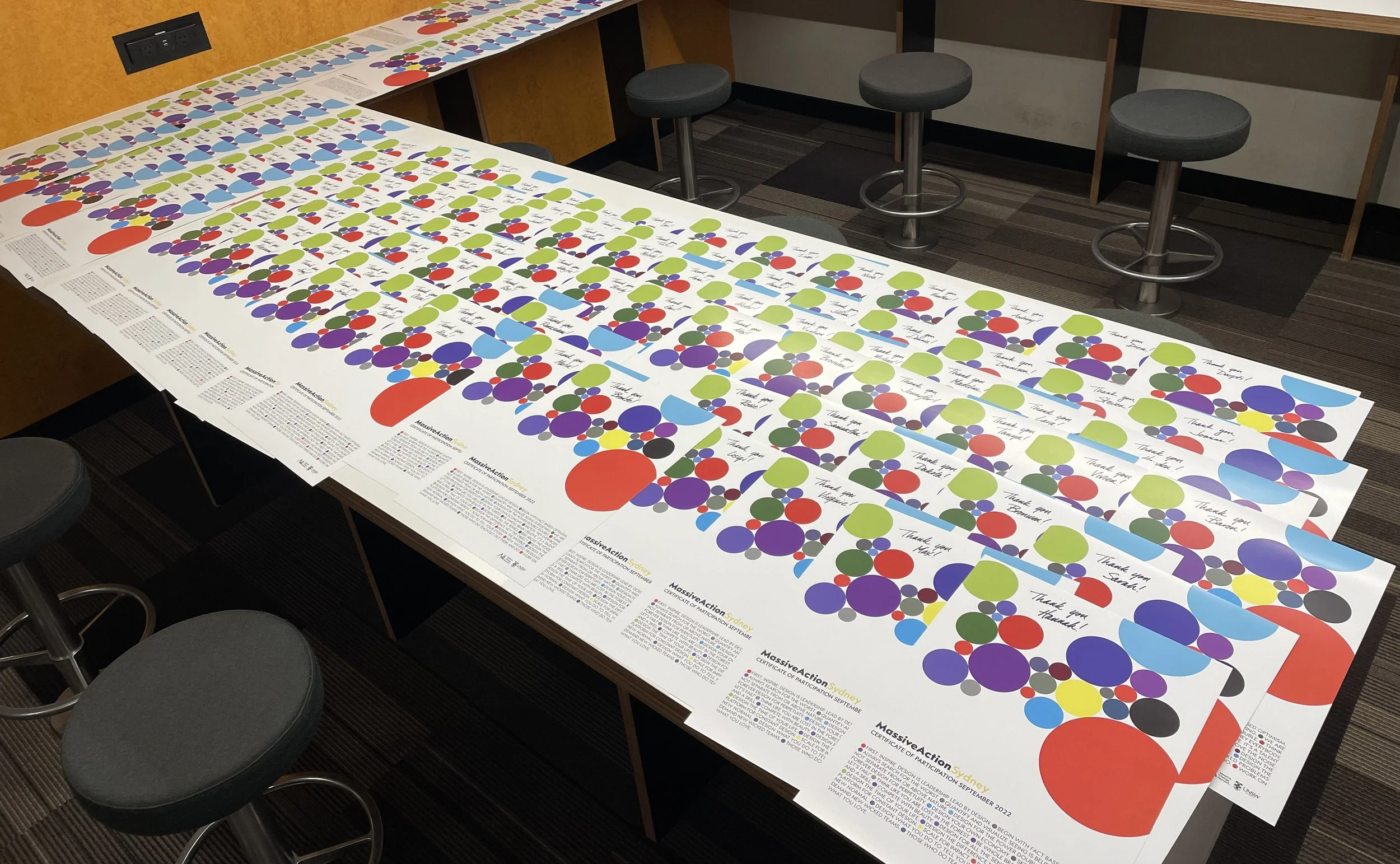
MASSIVE CHANGE NETWORK MASSIVE ACTION SYDNEY
Designing stability amid momentum
MASSIVE ACTION SYDNEY AT A GLANCE
ENGAGEMENT FORMAT
Project Partnership → Stewardship Support
CONTEXT
Bookends of a month-long international design immersion developed under extreme time, scale, and organizational change.
MY ROLE
Executive project leader within a newly formed, globally distributed team.
FOCUS
Stabilized creative chaos; established structure, cadence, and decision clarity under a fixed 10.5-week deadline.
OUTCOME
Successful delivery of MASSIVE ACTION Sydney and post-program synthesis carried forward by the internal team.
“Gretchen didn’t take over the work — she made it possible for the team to do its best work. She brought calm, structure, and judgment at a time when we were all new and navigating uncertainty, and that made a lasting difference in how both the project and our team dynamic came together.”
— Jessica Fenner, MASSIVE ACTION Project Manager
CONTEXT
When I joined Massive Change Network (MCN), MASSIVE ACTION Sydney was already in motion — and nearly everyone responsible for delivering it was new.
Beyond the studio’s principals, the core project team looked like this:
5 of 6 people assigned were new to the project
4 of 6 were new to MCN (less than one month in)
2 of 6 were new to their roles or to the design industry entirely
The project is why the studio scaled up this way. It dominated the studio’s capacity. Well beyond one initiative among many; it was the primary work.
Shared history was non-existent. Institutional memory was thin. The work ahead was significant.
Time was the governing constraint. There were 10.5 weeks between my first day at MCN and wheels up on a trans-Pacific flight to Sydney. Also, because Sydney operates 15 hours ahead of the studio, that window functioned as a hard deadline for nearly all deliverables.
At the same time, the internal team was fully distributed. I was the only person physically present in the studio. Others were working remotely across New York, Milwaukee, Toronto, and home offices within driving distance. Roles existed, but task ownership was diffuse —not unusual in a fast-moving creative environment — while overall project ownership had yet to consolidate. That gap became visible quickly, and in week two of my tenure, I needed to take responsibility for stewarding the project as a whole; there was no other choice at the time. Further,. once the principals and I landed in Sydney, the work would shift irreversibly into execution mode. There would be no opportunity to catch up later.
Ambition was not the problem. Talent was not the problem. The question was how a group of capable people — new to one another, new to the organization, new to the commitments made to the client, working remotely, and operating under a non-negotiable deadline — could stabilize quickly enough to support the work ahead.
DESIGNING THE CONDITIONS FIRST
Before curriculum, content, or experience design could move forward, the conditions under which the work would happen had to be sorted.
My role in those early weeks was not to invent ideas or dictate outcomes. It was to bring calm, order, and structure to a system already in motion. That meant establishing shared priorities, clarifying decision sequences, and introducing rhythm where there otherwise would be urgency without cadence.
Stability, in this context, was not about control. It was about reducing unnecessary friction so energy could be directed toward the work itself. We needed visible structure — checkpoints, ownership clarity, and decision frameworks — not to slow momentum, but to prevent it from becoming brittle.
This was especially important given the distributed nature of the team. Without shared physical space, trust had to be designed. Progress needed to be visible. Dependencies had to be explicit. Systems needed to reduce reliance on individual heroics and make forward motion legible to everyone involved.
Order, once established, enabled autonomy.
WORKING UNDER A FIXED HORIZON
The 15-hour time difference sharpened every decision. It forced prioritization early and removed the illusion that anything could be “figured out later.” Every unresolved question carried downstream consequences. Every single delay compounded risk.
This constraint shaped not just what we worked on, but how. Decisions were sequenced deliberately. Workflows were aligned against the same horizon. The goal was not perfection, but readiness — ensuring that when we arrived in Sydney, the system could hold.
THE IMMERSION
The month-long MASSIVE ACTION immersion in Sydney was, by any visible measure, a success. Engagement was high. The cohort was energized. The work landed.
But the immersion itself is not the center of this story.
What mattered more was that the program worked because the conditions behind it held. The creative work was able to do its job precisely because stability had been designed in advance.
AFTER THE RETURN FLIGHTS
The work didn’t end when the immersion concluded.
In the weeks and months after we returned, I took on another leadership role — this time focused on helping the team collectively make sense of what had happened. Together, we reflected on what worked, why it worked, and what the Sydney experience revealed about how MASSIVE ACTION could be designed and delivered going forward.
That work involved distilling shared learning, aligning perspectives, and translating lived experience into a coherent narrative. The goal was not to memorialize a moment, but to ensure that what had been learned could be carried forward and scaled.
Experience without reflection remains anecdote.
Reflection — when done together — turns past experience into future practice.
REFLECTION
MASSIVE ACTION Sydney reinforced something I have seen repeatedly across contexts: creative leadership often begins before creative work is visible.
Whether or not teams are distributed, when time is fixed, and stakes are high, calm becomes an active design choice. Structure becomes a form of care. Stability, when well designed, disappears — leaving behind only the work it made possible.
Massive Change Network® and Massive action® are registered trademarks of Massive Change Network, LLC.